
Looking Closely at Numbers
…and the freedom and optimism they provide

Try to imagine our lives without numbers. I think this is a nearly impossible thing to do.
They are like structural beams, irreplaceable descriptors for so many things—the number of miles we drove, the number of days it took, the number of repetitions in an exercise, garlic cloves in a recipe, pieces in a serving size, pages in a book, the currency in my wallet or my bank account, poll numbers, calories, the number of bags I can check at the airport, the number of seats in a classroom, in a theatre, in a stadium, the number of years left on my mortgage,…Most of us cannot navigate the details of our lives without being able to count. And that’s the key. Counting seems natural and necessary.
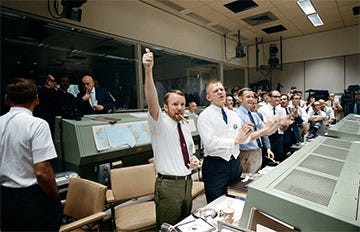
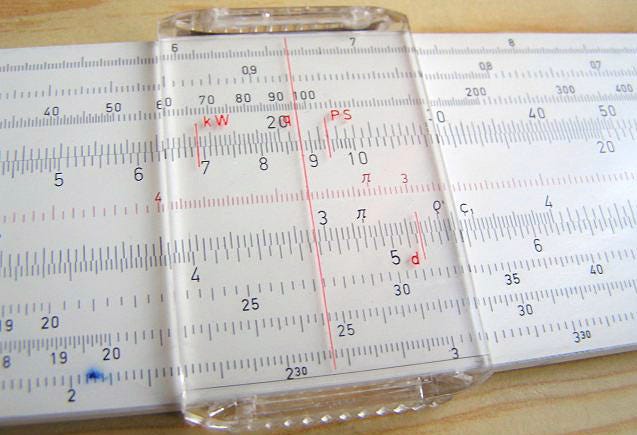
Is a discussion of numbers worthy of our attention? Most certainly if we want to get a look at something remarkable about the power of simple thoughts. I remember watching the ground engineers in the film Apollo 13 running around the Houston control room with pencils and slide rules. They needed these five-inch long strips of aluminum and plastic (which dramatically simplified calculations using logarithms) to rescue the flight crew—three men, packed into a damaged space vehicle, moving through the empty, dark space between the earth and the moon. The ground crew couldn’t fly there and lug what was left of the rocket back to earth. They had to guide the direction of this completely inaccessible and broken transport by calculating the values of trajectories, velocities, and forces with numbers. They had to manage the vehicle’s life-sustaining power supply, power consumption, and carbon dioxide levels, as well as the astronauts’ breathing rates, and oxygen consumption with numbers. And they succeeded!
This is one of the wonders of mathematics. When a problem and its solution are completely out of reach and you can’t get your hands around the thing you are trying to manage, these crystalized thoughts that began as counting, get it done.
But the numbers those engineers used are not exactly the same as the ones we use to count calories. They have gone through their own evolution, negotiated with the work of open human minds, because the numbers we thought we understood had some quirks we didn’t anticipate.
Counting is not a uniquely human talent. Researchers studying numerosity—the name given to an organism’s ability to respond to quantity—have found that counting exists in many animals including birds and insects, as well as rats and primates. There is evidence that crows respond to the concept of zero, and newly hatched chicks can do a little arithmetic. Even fish can count. The brain circuitry in these creatures is not the same as ours, yet these so-called abstract notions show up in the action of their lives. This suggests the action of counting belongs to the senses rather than being a clever device we humans came up with to manage modern lives.
In us, however, quantity became objectified, each number an image of some kind. And then we investigated these images, pretty thoroughly. It’s as if the intellect looked into itself. What else could it see with numbers? And what developed is as remarkable as the emergence of simple animals from clusters of specialized cooperating cells—a number system capable of directing a broken Apollo 13.
Imagine starting with something as simple as matching each pebble in your hand with each animal in your herd as a way to make sure you didn’t lose any of them. The perception, the thought, and the action are all one thing. Now instead of using a pebble, notch a piece of wood or stone for each animal. This looks more like counting. Symbolizing the total number of notches is yet another step—one of our earliest of symbolic figures. The oldest representations of distinct quantities date back to about 3000 B.C. Mesopotamia. The oldest known representation of zero seems to have happened between 700 and 600 B.C. The Arabic numerals, which originated in India, and which for us are just numbers, were in use in Europe in about the 10th century. Then there are fractions, a way to use integers to represent pieces of some one thing, such as one fourth of a pie or one half acre of land. Representations of parts of a whole existed in Egypt as far back as 1600 B.C. Ratios, a slightly different kind of relation, were explored in Ancient Greece. Hindu mathematicians expressed the idea of a fraction in a more familiar way beginning in 630 A.D. Fractions didn’t show up in Europe until the 16th century.
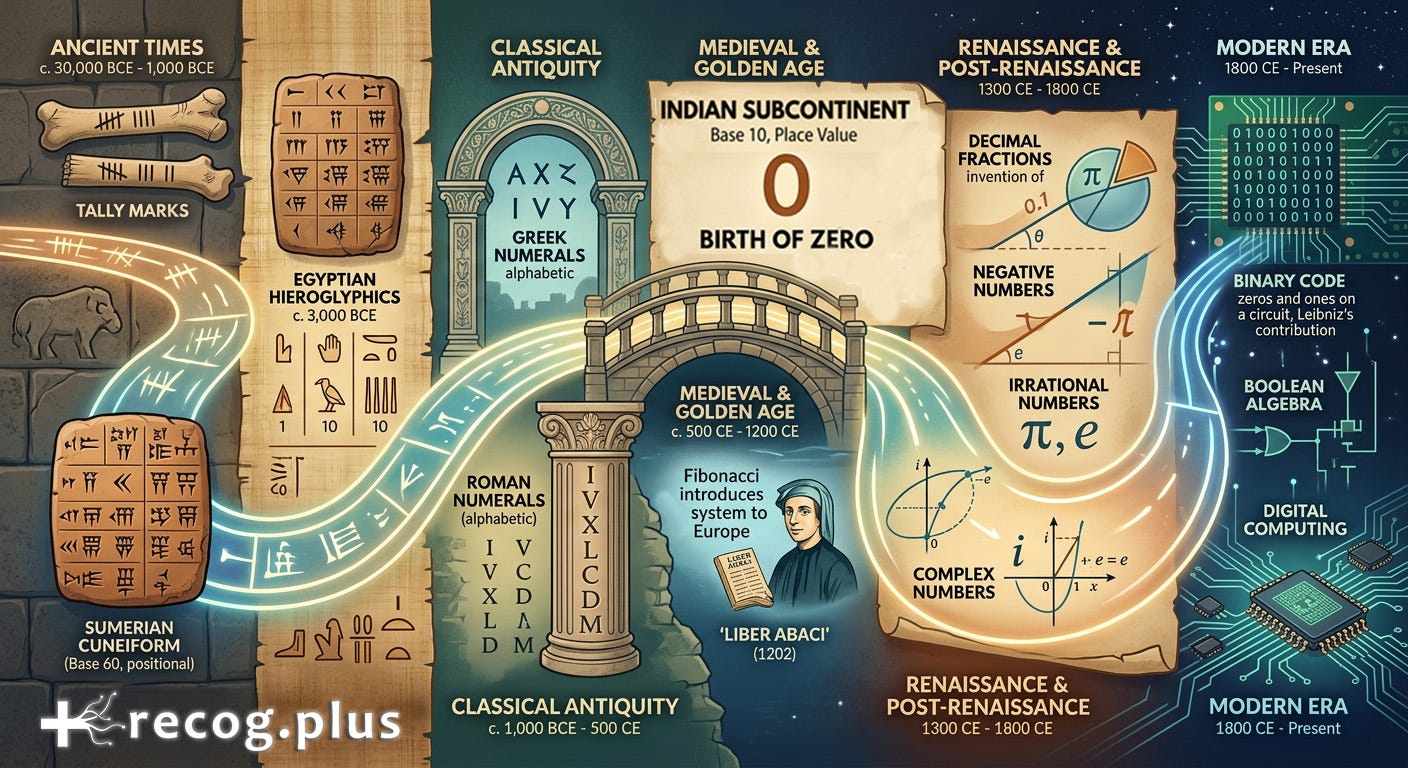
Different ways of representing counts and measures were designed over thousands of years across multiple civilizations. Then the number √2 shows up, a number which we will see is neither an actual length nor is it a quantity even though it looks like one. So, what is it?
Just to refresh our memory the most well-known √2 shows itself in the right triangle using the Pythagorean Theorem. If a2 + b2 = c2
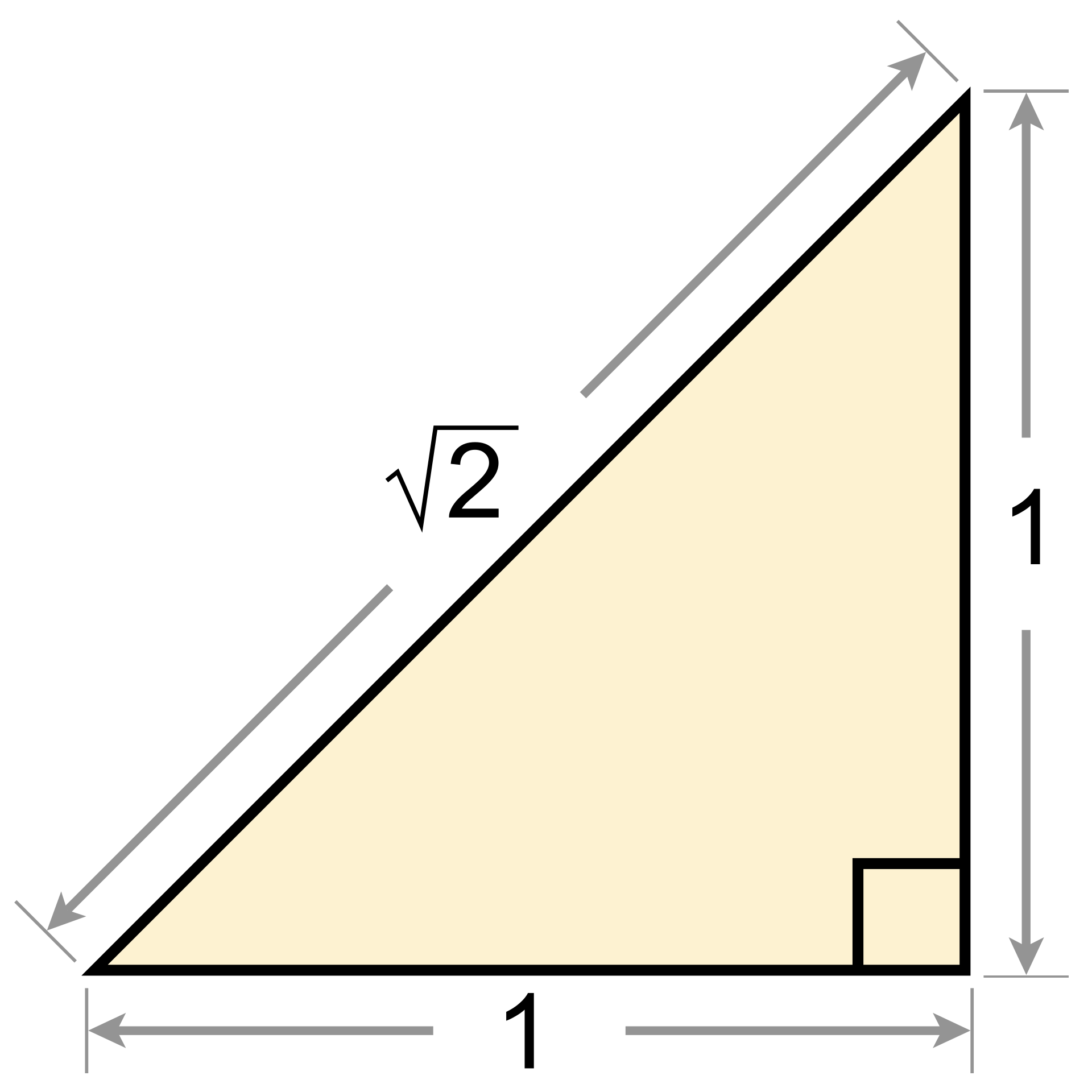
Then when each of the legs of a right triangle measures 1, c2 = 2 or
This is a fact with multiple applications and yet it produces a number we don’t understand.
The problem is that there is no whole number or fraction which when multiplied by itself is equal to 2. The decimal expansion of this peculiar root never ends and never repeats (the way, for example, 1/3 =0.333… forever repeating). √2 is what we call an irrational number. But let’s see what this means in a more familiar way.
The √2 is also referred to as an incommensurable length meaning there is no way to compare this length to another length exactly. To be very clear, if we were to measure the length of a carpet and find it is five and a half feet long, we could use a half-foot as our unit and say instead that the carpet is eleven of these half-foot lengths long. The half-foot length becomes our unit. If the carpet was √2 feet long, however, there is no smaller unit that would fit exactly into that length. This is not because the number is small (a value between 1 and 2 and closer to 1). It just cannot be done. √35 has exactly the same problem. Yet the mathematics that brought the Apollo 13 crew home requires that these numbers be included in our number system. Every square root of a number that is not a perfect square (like 4 or 9 or 16, etc.) is anomalous in this way. And they all sit on the real number line, a continuum we learn about in high school if not earlier. In mathematics we avoid the problem of having to say what √2 signifies. Taken as a set, the real numbers only have meaning in relation to each other. And without these irrational numbers, more sophisticated mathematics like calculus is not possible.
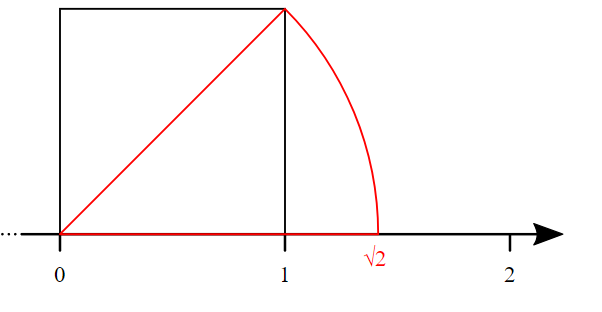
The real number line has more irrational numbers on it than rational ones. They are needed to produce the gapless continuum of numbers on the line. And this smooth transition through numbers is necessary to speak about continuous things like duration, length, area, and intensity—things that flow and have no gaps—as opposed to discrete things like apples and oranges. In his classic book, “What is Mathematics?” Richard Courant refers to the identification of these incommensurable lengths as, “a scientific event of the highest importance.” In other words, our recognition that numbers do not need to conform to what we believe they should do is a critical observation from the intellect. This is not the only surprise we found in our exploration of numbers. The imaginary unit is another. But we’ll look at this one another time.
All of these surprises and more emerge when the intellect or the thought, reflects back on itself, explores itself. I find this unexpected extension of what first appeared bounded or fixed to be similar to what happens with the consistent extension of Olympic feats. In figure skating in particular the sport went from the measured tracing of intricate figures in the ice to unimaginable spinning and jumps with increasing numbers of rotations in the air. The athlete’s extension of the body’s potential speed, endurance, or strength is like the mathematician’s extension of the intellect’s range. When we investigate mathematical ideas, we grow more concepts and extend our ability to reason through some of life’s mysteries the way an athlete extends the limits of what the body can do.
Interestingly enough, researchers in cognitive psychology have found evidence suggesting that a system for numeric reasoning with real numbers evolved before language. It seems the brain does not treat temporal perception, spatial perception and perceived quantity differently. Action related to more than or less than, faster or slower, nearer or farther, bigger or smaller are handled the same way. The neural processing of size is generalized. It may be that when language evolved, it picked the integers out from sensations that resembled the real number continuum, making the integers the beginning of our objectified mathematics with which we would build back the continuum we had already experienced.
While numbers look to us now like common sense instruments, it’s important to realize that they were eventually found to defy common sense. They are more like sensory data than they are like fingers. And in the hands of mathematicians, they gave us access to so many of the things we can’t see or explain. Rarely addressed is how this conceptual product of our nervous system reflects something important about us—namely, how deeply we can look into our own thoughts and how well these thoughts are coupled to the world around us. Numerosity, a quality inherent in the physical negotiation of day-to-day action, later takes shape as a concept which gives us access to a kind of freedom that physical constraints deny—freedom to accomplish what looks impossible. Far from obvious and mundane, numbers indicate that if we keep looking, without rejecting what we don’t like or what we don’t understand, we always find more.
References:
Behavioral and Neuronal Representation of Numerosity Zero in the Crow, Maximilian E. Kirschhock, Helen M. Ditz and Andreas Nieder, Journal of Neuroscience 2 June 2021, 41 (22) 4889-4896; https://doi.org/10.1523/JNEUROSCI.0090-21.2021
Animals Count and Use Zero. How Far Does Their Number Sense Go? Jordana Celelewicz, Quanta Magazine, August 9, 2021
Bueti, D. and Walsh, V. (2009) The Parietal Cortex and the Representation of Time, Space, Number and Other Magnitudes. Philosophical Transactions of the Royal Society of London B: Biological Sciences, 364, 1831-1840.https://doi.org/10.1098/rstb.200
Glad you shed some light on this, on how numbers are not just an intellectual invention but an intuition/sense so foundational that it is seen in the development of various animals (including ourselves). Thought the part about how we perceive changes in size, speed, and proximity similarly was a particularly interesting point
Another cool addition to this would be some of the earliest computers or theoretical machines from the first half of the 20th century. I remember taking a class about algorithms once where the professor showed us some basic machines, similar to the finite state machine but more primitive, that would often use counting to accomplish certain tasks differently than we might do so with symbolic algebra. While these were limited in what types of things they could do, it was neat to see the concept, especially when taking into consideration how things like those eventually evolved into the Turing machine and physical tape computers that formed the basis of modern computing.