
Forever yours,
and the faces of infinity

In this month’s lead post, “Minding our Images,” I expressed the optimism I glean from the neverendingness of mathematics as it reflects the mind’s infinite and unknown potential. How does anything infinite fit into our finite world?

“Forever yours, Albert.” was how my dad signed all of his cards and letters to my mother, all of them. My father was drafted into the army during World War II. While away, he sent a drawing to my mother with each of his letters. Often, they were on the envelopes. He was not a dramatic individual and often made jokes at his own expense. I have no doubt that, for him, my mother was all of the pretty girls he liked to draw. He called her Angel instead of Pauline. He would not have signed off “Forever Yours,” on everything if it wasn’t meaningful to him.
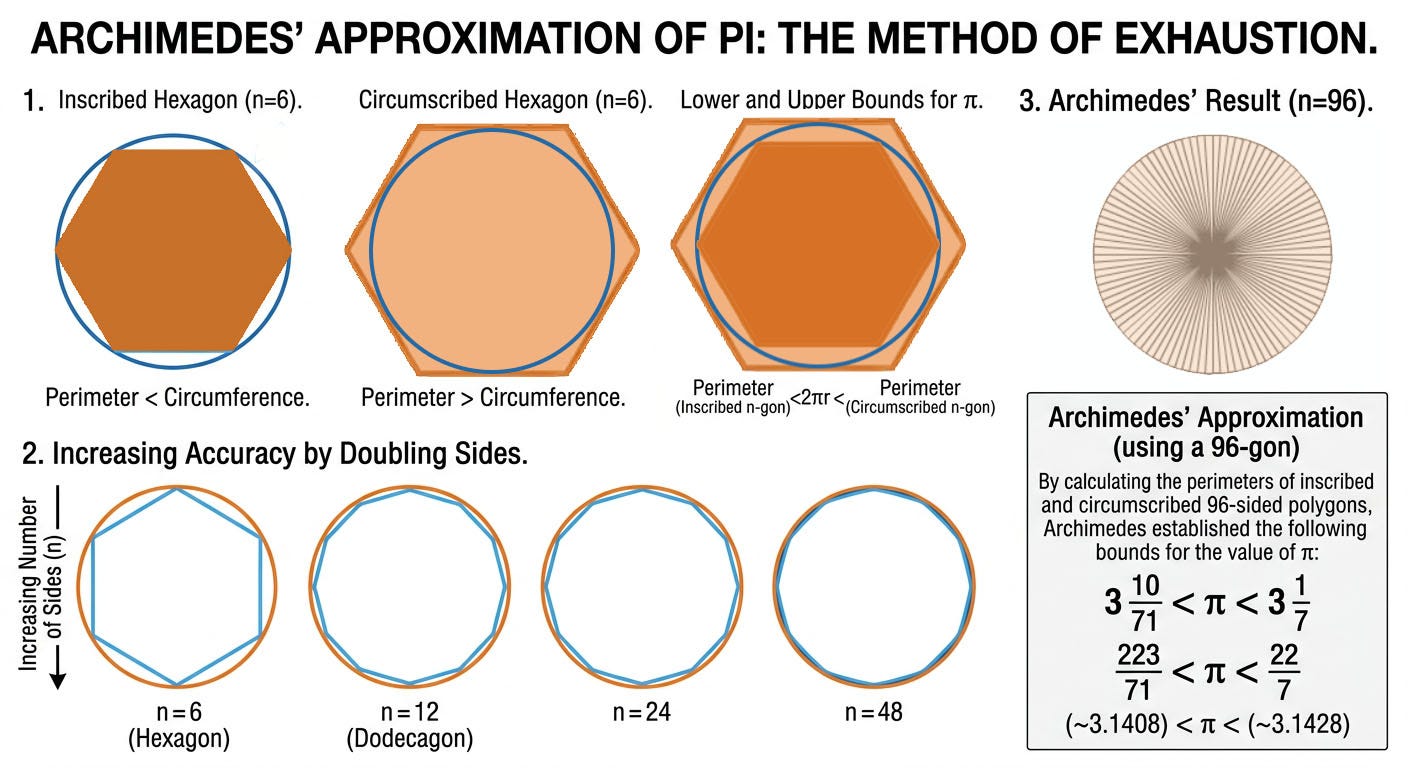
Forever is a common word in our vocabulary. Eternal is another one which signifies a slightly different kind of endlessness. But endlessness has a special place in mathematics. It takes many forms—the infinite extension of the number line in both directions, its infinite divisibility, the infinite collection of points on the line, the endlessness of our approximations of π, the point at infinity where parallel lines meet. A useful endlessness was once used in the Ancient Greek process of ‘exhaustion.’ Archimedes squeezed the area of a circle between two regular polygons (figures with straight edges and sides of equal length) by increasing the number of sides of the polygon inside the circle and the polygon about the circle. Continuing this process over and over brings the polygons’ edges ‘infinitely’ closer to the circle’s. Archimedes approximated the value of π pretty accurately with this construction using a 96-sided polygon.
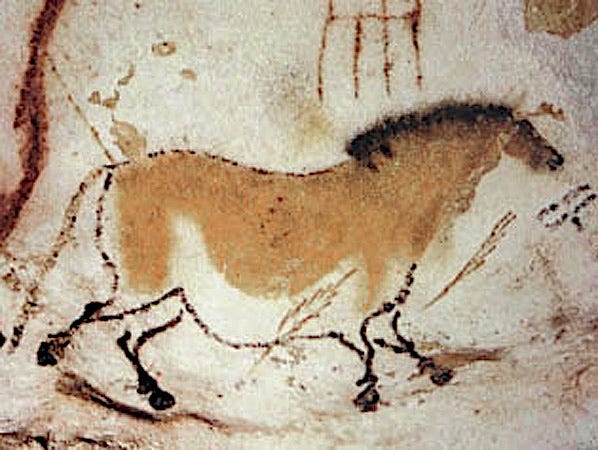
Where do we get these ideas of endlessness in the very finite world we inhabit? Let me suggest that our ideas of endlessness are intuitive, a consequence of our interaction with everything. Every aspect of being alive is an interaction—our muscles against the ground, our eyes’ response to light, our image-making neurons, even breathing itself. The imagination is active in all of these experiences. There is a notable circularity in early cave paintings when some of our oldest ancestors took the ground into their hands (specifically pigment from minerals or charcoal), then with their memory, their eyes, and their hands reproduced on underground cave walls images of what they had seen in the daylight. Very early musical instruments are just the direction of air, an individual’s breath, through a shell, a branch, or an animal bone, to make sound like the sound already present in wind. The rhythm from the heart and the lungs is externalized with the rhythmic pounding of animal skin stretched over a hallow frame made from bark. Once amplified, the rhythm is brought through the senses again and we dance! These actions are all thoughts.
Every elaboration of these actions is more interaction—producing cultures rich with music, painting, dance, literature, and science. The ground, the muscles and the intellect are constantly engaged and continuously creative, and it seems without end. There is no end to the potential for these interactions. We know this. And this may be the infinity we feel intuitively. We cannot pull ourselves out of these interactions and, for this reason, our view is always incomplete. But mathematics has made it possible to see more about relations (like the relations between the movement of air and sound) than we can see directly.
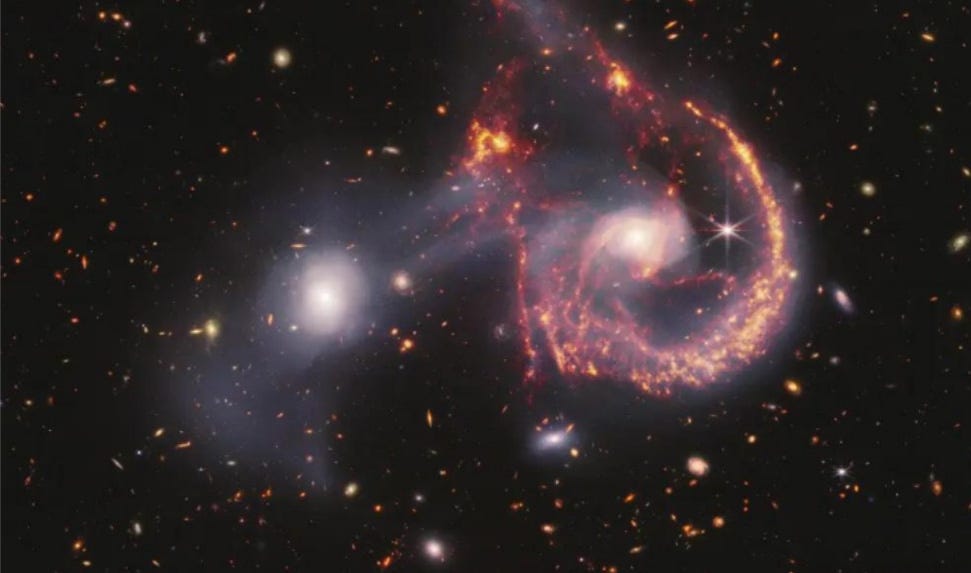
Exploring infinity became necessary in mathematics. And mathematics has been necessary to our scientific understanding of the physical world. This is what supports all of our technological feats. Grabbing hold of thoughts or concepts with mathematics, we find a way to see beyond our visual range and even to make images of colliding galaxies 465 million light years away, to say nothing of the fact that we can call up these images of our universe’s history on hand-held devices developed for communication.
It does look to me like the deeper we search our ideas, the more ways we find to look within our own nature, the further our eyes can see and the bigger our world becomes. The body, the mind, and the world cannot be separated. Time, after all, is measured in heartbeats.
Image sources:
“Suddenly…” by Albert DiNunzio
KKH
By Own work, Public Domain, https://commons.wikimedia.org/w/index.php?curid=1907853
ARP 107 James Webb Space Telescope
Love this! I remember those drawings and how your dad called your mother Angel…every time! Such a sweet man! I have such fond memories of both of your parents ❤️